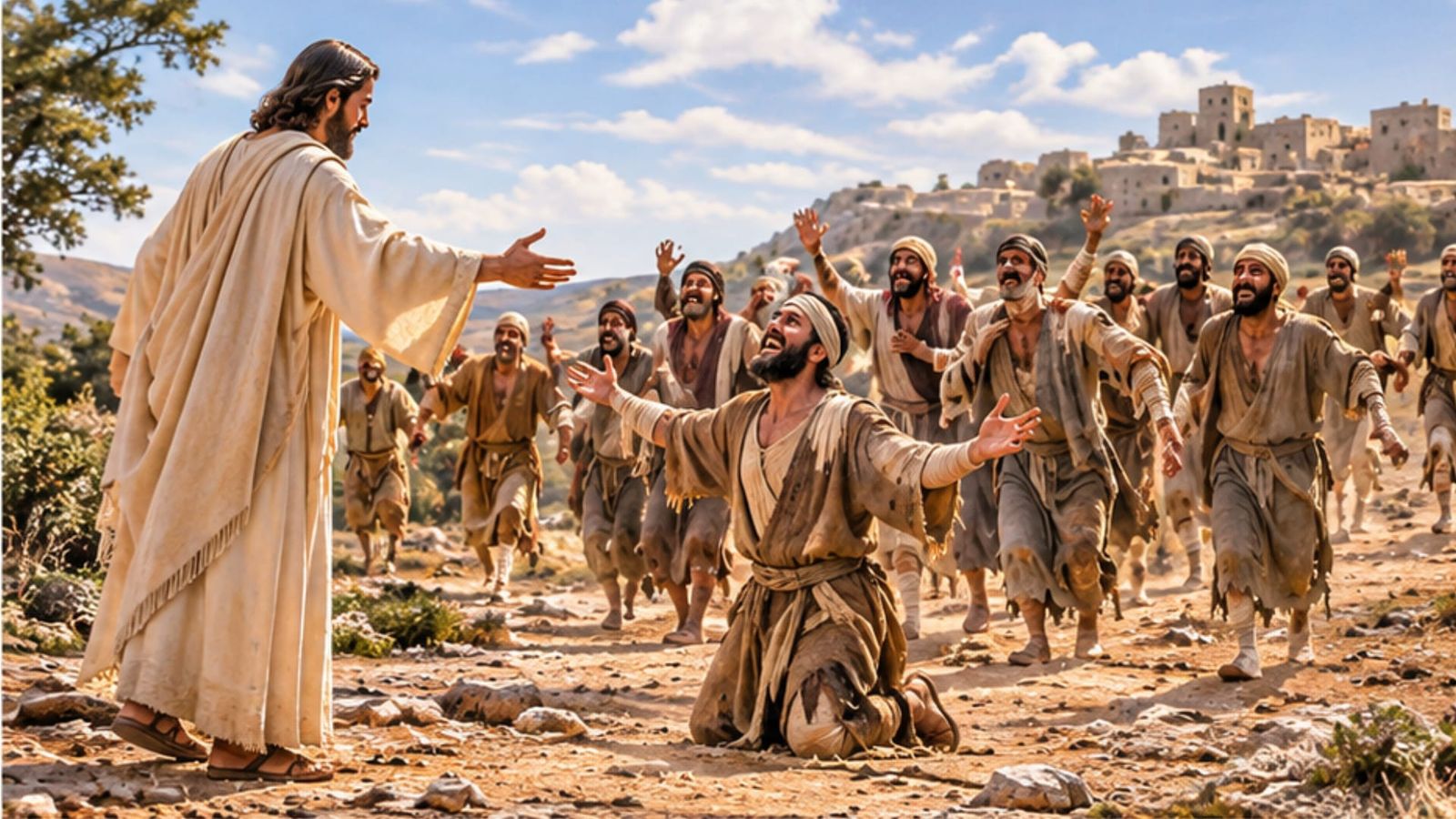
Ten men stood at a distance and shouted. Nine of them did what Jesus told them to do, and their skin cleared as they walked. Only one stopped, turned around, and came back. Luke records the moment in a single sentence, and most of us read past it on the way to the next story. Yet that sentence raises a question that Thanksgiving tends to press on us every year: what, exactly, makes gratitude possible?
Thanksgiving is a strange holiday. It is warm and heavy at once. There is the smell of the kitchen, the noise from the next room, and the relative who always asks the question you hoped no one would ask. There is also an empty chair, which may hold a loved one who has died, or a relationship that has gone quiet for a long time. For some, the season arrives in the middle of a hospital waiting room or a difficult year at work, and the idea of a grateful heart can feel almost offensive. So the honest question deserves an honest hearing: is gratitude still possible in a year like that?
Gratitude, as I understand it, is a heart response. It is the recognition that something good has been given to us and that Someone gave it. Thanksgiving is what gratitude becomes when it takes shape in words and actions, especially words spoken directly to God. Yet the deeper question sits underneath these definitions. Does gratitude arise from our circumstances, from having enough, from things going our way? Or does it spring from somewhere more durable?
The Turn
Luke tells us that Jesus was on the way to Jerusalem, which means he was on the way to the cross. Every step is deliberate. Along the border between Samaria and Galilee, where Jews and Samaritans lived uneasily beside one another after centuries of mutual suspicion, ten men with leprosy approached him. Scripture's use of the word "leprosy" covered a range of skin conditions, and the Old Testament law was concerned less with the precise diagnosis than with ceremonial uncleanness. That phrase describes a state of being set apart from worship and community. It was not a moral verdict. It was a boundary, one that Leviticus 13 describes in careful detail. A person so marked could not enter the sanctuary or move freely among family and neighbors.
Imagine living on the far side of that boundary, cut off from everyone you loved, not because of something you had done but because your body was not right and no one could make it right. These men obeyed the rule and kept their distance. Then they cried out, "Jesus, Master, have mercy on us!" Mercy is compassion toward someone in real need, a kindness that does not have to be earned. They were not bargaining. Their plea was plural, too: us. Their shared suffering had made them a fellowship of need.
Jesus did not touch them or pronounce a healing word. He told them to go and show themselves to the priests, which was exactly what the law required of a man who believed himself cleansed (Leviticus 14 describes the process). In other words, he asked them to act as healed men before they looked healed. Luke gives us the result in one line: "As they went, they were cleansed." They obeyed in the middle of their need, and the healing came on the road.
Then one of them turned around. Luke writes:
"One of them, when he saw that he was healed, came back, praising God in a loud voice. He fell on his face at Jesus' feet, giving him thanks. And he was a Samaritan." — Luke 17:15–16 (CSB)
Luke's final clause carries real weight. The man who returned was the outsider, the one his neighbors would have looked down upon, and yet he was the one who understood the gift best. Jesus notices the difference: "Weren't all ten cleansed? Where are the other nine? Didn't anyone other than this foreigner return to give praise to God?" — Luke 17:17–18 (CSB). Jesus does not condemn the nine. They were healed, and they were glad. They simply went on with their lives and never turned back to the One who had healed them.
The distinction Jesus draws at the end of the story is subtle. The Greek word translated "saved" in verse 19 is sōzō, which means to rescue and to make whole. All ten men were cleansed of their disease, but only one was made whole in the fuller sense. The other nine received a gift and walked away with it. The one returned to the Giver and was restored to Him. Jesus said to him, "Get up and go. Your faith has saved you" (Luke 17:19, CSB).
Scripture offers a few other threads to hold alongside this story. In 2 Kings 5, Naaman the Syrian commander was healed of leprosy after he washed in the Jordan River at the word of the prophet Elisha, and his healing led him to confess that there is no God in all the earth except in Israel. Healing became a doorway to worship. Romans 1 traces the opposite path. When people refuse to honor God or give Him thanks, their thinking grows futile and their hearts grow dark. Ingratitude is a form of forgetting where life comes from, and over time that forgetting dims the soul.
So gratitude is more than enjoying a good thing. Anyone can enjoy a gift. The more searching question is whether we turn around far enough to see the One who gave it. A clean scan, a steady paycheck, a child who came home safe, a friend who showed up when no one else did: these are real gifts, and they are worth enjoying. But the Samaritan reminds us that they become a doorway to worship only when we turn toward the Giver and say His name.
A People Who Sing
If the Samaritan shows us the posture of a single heart before God, the apostle Paul shows us what that heart looks like in community. In Colossians 3, he writes to a congregation he had never visited in person, shaping their life with a sequence of commands. But before he gives a single instruction, he gives an identity:
"Therefore, as God's chosen ones, holy and loved, put on compassion, kindness, humility, gentleness, and patience." — Colossians 3:12 (CSB)
The order matters. Chosen means God set His love on His people before they ever chose Him. Holy means set apart for His purposes. Loved means they are not strangers to His heart. Paul's commands grow out of that identity. We do not thank God in order to earn a place in His family. We thank Him because we already belong to Him.
Paul then speaks of peace. He writes, "And let the peace of Christ rule in your hearts, the peace you were also called to in one body" (Colossians 3:15, CSB). The word translated "rule" is a picture from the athletic contest, describing an umpire whose decision is final. Paul is saying that Christ's peace should be the thing that settles what happens in our hearts. Biblical peace is more than the mere absence of conflict. It is shalom, the Old Testament word for wholeness and right relationship with God and others. The peace Christ secured at the cross is that wholeness, and when it rules, we do not have to win every argument to know that we are held.
The shortest sentence in the passage follows: "And be thankful." Paul does not dress it up. He places it at the center of his teaching on peace and the word, as though to say that gratitude is the natural response to everything he has just described. Thanksgiving is not a bonus for people who have had an easy life. It is the answer of people who have been chosen, loved, and made peaceful by Christ.
Paul also writes that the word of Christ should dwell among the people "richly" (Colossians 3:16). Here "word" refers to the message about Christ and the teaching that flows from Him and His apostles, which Christians have received as Scripture. When that word settles into a community, it shapes how people think and speak. It also shapes how they sing: "singing psalms, hymns, and spiritual songs with gratitude in your hearts to God" (Colossians 3:16, CSB). Psalms come from the Psalter, the ancient songbook of Israel. Hymns exalt God directly. Spiritual songs are shaped by the gospel and by the Spirit's work in the lives of those who sing them. Paul's picture is communal. Gratitude is not a private achievement. It is learned in a room full of voices.
I think of an older man I will call him Frank. Frank loved to sing in choir. In his later years his hands trembled so badly that he could barely hold a hymnal, and some Sundays he could hardly manage a single line. But when the congregation sang, he closed his eyes and let the voices around him carry the words. One Sunday, a young mother seated beside him noticed his silence and began singing a little louder, so that his part was covered. Frank told her afterward that it was the closest he had come to worship in months. Sometimes a community sings on behalf of the one who cannot sing.
Paul's instruction reaches further than the worship service. He writes that whatever we do, "in word or deed," should be done "in the name of the Lord Jesus, giving thanks to God the Father through him" (Colossians 3:17, CSB). Gratitude belongs at the kitchen sink, in the middle of a Tuesday errand, and in the way we speak to a difficult coworker. It is a whole way of living.
Thanks in Everything
Every Thanksgiving, someone quietly wonders whether gratitude is still required when life has gone badly. Paul's first letter to the Thessalonians addresses that very question. He writes:
"Rejoice always, pray constantly, give thanks in everything, for this is God's will for you in Christ Jesus." — 1 Thessalonians 5:16–18 (CSB)
Look closely at the phrase "give thanks in everything." It does not say "give thanks for everything." That small preposition carries a great deal of theological weight.
Paul wrote to a young church born in hostility. According to Acts 17, his preaching in Thessalonica provoked such opposition that he had to leave the city by night, and the believers who remained were living in no comfortable age. So when Paul tells them to give thanks in everything, he is not speaking from a quiet porch. He is speaking to people who knew suffering firsthand.
To give thanks for everything would mean believing that every event is good in itself. It would mean thanking God for cancer, for betrayal, for the death of a child. Scripture does not ask that of anyone. Sin is sin, and death is an enemy. No one is obligated to thank God that a loved one is gone or that a body is failing. But to give thanks in everything means that even in the hardest moments we turn toward God and say, in effect, "You are still good. You are still present. You are still at work, even where I cannot see it." Gratitude is not the denial of pain. It is the decision to bring the pain into God's presence and keep speaking His name inside it.
The Psalms give believers language for this kind of honesty. Lament is the raw cry of a suffering person addressed to God, and it is not a lapse in faith. It is one of the ways faith speaks. Psalm 13 opens in real anguish:
"How long, LORD? Will you forget me forever? How long will you hide your face from me?" — Psalm 13:1 (CSB)
The psalmist keeps asking. He does not pretend that the pain has gone away. Then, somewhere in the psalm, the tone shifts:
"But I trust in your faithful love; my heart rejoices in your salvation. I will sing to the LORD, for he has treated me generously." — Psalm 13:5–6 (CSB)
We cannot be certain whether the psalmist's circumstances changed between the opening question and the closing confidence. The turn may be one of trust more than of situation. Either way, he did not wait for everything to be fixed before he gave thanks. He held the lament and the thanksgiving in the same hand. The grief found a place to stand, and so did the trust.
Gratitude of this kind is not forced. Someone who is grieving may hear a well-meaning friend say, "Just be thankful," and feel the sting of it. Paul is not describing a mood that must be manufactured on demand. Real thanksgiving grows out of trust, and trust is often built slowly, in the dark, one honest prayer at a time.
Paul's sentence also explains why this kind of thanksgiving is possible at all: "for this is God's will for you in Christ Jesus." Paul does not promise a pleasant life. He anchors the call to give thanks in Christ, and the apostle elsewhere writes:
"But God proves his own love for us in that while we were still sinners, Christ died for us." — Romans 5:8 (CSB)
That is the foundation of Christian thanksgiving. Gratitude does not depend on our circumstances remaining secure. It rests on a love that has already been proven at the cross, a love that does not evaporate when the test results come back.
For anyone who wants to try this in practice, a simple exercise can help. On a single page, write two columns. On the left, list what is hard: what hurts, what you are asking God about, what you cannot make sense of. Don't tidy it up. On the right, write one small thing you can still thank God for, even if it is a cup of coffee or a message from a friend. The two columns need not agree with each other. Let them stand side by side before God. The grief may still ache, but it has a place to stand, and you are not standing alone.
The Peace That Guards
If gratitude can live in the same heart as sorrow, the next question is how God's peace reaches us in the middle of that sorrow. Paul, writing from prison and uncertain about his own future, answers that question in Philippians 4. It is one of the most joyful letters in the New Testament, and its joy is anchored not in circumstances but in a Person. The phrase "in the Lord" runs through the whole letter.
Paul's instructions about anxiety come with a striking invitation:
"Don't worry about anything, but in everything, through prayer and petition, with thanksgiving, present your requests to God. And the peace of God, which surpasses every thought, will guard your hearts and minds in Christ Jesus." — Philippians 4:6–7 (CSB)
Notice the structure. Paul does not say that anxiety will vanish once we pray correctly. He says that we are to bring our requests to God, and that the peace of God will stand guard. Prayer is speaking with God in general. Petition is the more specific act of naming a need. Then Paul adds thanksgiving. We bring our requests with thanksgiving, which means that gratitude is not something we tack on after we receive what we asked for. It is the posture we take as we bring our needs forward.
Think about the difference this makes. A person who prays from desperation approaches God as a beggar with nothing to offer. A person who prays with thanksgiving approaches God as a child who already knows the Father is good. Thanksgiving changes the tone of the entire conversation. It reminds us that God has been faithful before, and so we ask with confidence rather than despair.
Paul's promise uses a military image. The word translated "guard" describes soldiers posted at a city gate to keep enemies out. Imagine the heart as a city, the mind as its walls, and God's peace as a sentinel stationed at the gate. The peace that "surpasses every thought" does not wait for us to understand our circumstances before it arrives. Many people have sat in a room where nothing made sense, and a calm settled over them that they could not account for. That calm was not a trick of temperament. It was the guard at the gate.
Consider a couple I will call Marcus and Denise. They had a difficult year with money. A business that had supported them for a decade closed, and the bills kept arriving regardless. They were not reckless or lazy. They were simply in a season that had gotten away from them. One night, they sat at their kitchen table with a stack of envelopes and felt the old panic rising. Marcus suggested that before they opened another bill, each of them would name one thing they were thankful for. Denise thought the idea sounded a little silly. Then Marcus gave thanks that their daughter had made it home safely that week. Denise thanked God for a neighbor who had left a pot of soup on their porch without being asked. The bills did not disappear that night. But as they prayed, their requests and their thanks became tangled together, and the air in the room changed. Denise still did not know how they would pay everything. But she knew they were not facing it alone. That, she said later, was the peace Paul meant.
This is a pathway God provides, not a formula that guarantees results. Thanksgiving in prayer does not conjure money out of thin air. It changes the one who prays, and it opens the heart to the guarding peace of God.
Paul then turns to the mind. He writes:
"Finally, brothers and sisters, whatever is true, whatever is noble, whatever is just, whatever is pure, whatever is lovely, whatever is commendable—if there is any moral excellence and if there is anything worthy of praise—dwell on these things." — Philippians 4:8 (CSB)
Our minds are never neutral. They are always attending to something, and Paul invites us to attend to what is genuinely good. This is not a call to ignore the world. The list begins with whatever is true. Hard facts remain hard facts, and we bring them to God rather than pretending they are otherwise. But Paul also refuses to let the mind be trained only on darkness. A person who scrolls through the worst news every waking hour will likely grow anxious and bitter, whether intended or not. A person who fills the mind with Scripture, with the songs of the faithful, and with the faces of people who love them well will be shaped in a different direction. Paul is not asking for naivety. He is asking for wisdom about what we feed our hearts.
The passage ends with a promise and a practice: "Practice these things, and the God of peace will be with you" (Philippians 4:9, CSB). The language of practice is the language of discipline rather than instant transformation. Peace is not a switch we flip. It grows as we walk daily in prayer, gratitude, and attention to what is good. And the promise is not vague. It is the presence of "the God of peace" Himself. Christian peace is more than a feeling. It is the nearness of God.
The Gift Behind Every Gift
Every thread of this reflection leads back to a single source. The Samaritan returned to the Giver. Colossians describes a people chosen and loved and made peaceful by Christ. Paul's letter to the Thessalonians anchors thanksgiving in a love proven at the cross. And the letter to the Philippians locates peace in the nearness of God Himself. The gratitude we have been describing is not a mood we generate. It is a response to a prior gift.
That gift is the good news at the heart of the Christian faith. Scripture says plainly that "all have sinned and fall short of the glory of God" (Romans 3:23, CSB). Sin is more than a list of wrongdoings. It is the deeper condition of turning away from God and trying to be our own authority, and every human being knows something of that turning. Yet the same Scripture declares that "the gift of God is eternal life in Christ Jesus our Lord" (Romans 6:23, CSB). God did not leave us in that condition. Christ died for sinners, and three days later He rose from the grave, declaring that sin and death do not have the final word.
Christian faith describes the human response in two movements. Repentance means turning around, a change of direction in the heart that moves away from self-rule and toward the Lord. It is the same movement the Samaritan made when he came back to Jesus. Faith means trusting Christ alone for salvation. Scripture is clear that this salvation is not earned: "For you are saved by grace through faith, and this is not from yourselves; it is the gift of God, not from works, so that no one can boast" (Ephesians 2:8–9, CSB). Grace is God's undeserved kindness, and salvation by grace is the reason Christians can speak of thanksgiving without reservation. Nothing we bring to God pays for what He gives. Everything is a gift, and that is precisely why it is worth giving thanks for.
Scripture also speaks of this trust as a kind of calling on the name of the Lord. The Lord's promise is clear, as Romans 10:13 says that "everyone who calls on the name of the Lord will be saved" (CSB).
For those who have walked with God for years and have drifted, the same gift remains. Prayer can become a habit kept out of duty. The Bible can sit closed on the nightstand. The weight of ordinary days can leave a person weary, and gratitude can grow hard to find. The Samaritan's story offers hope even here. He did not need to be perfect in order to be received. He needed only to turn around, and Jesus received him.
Something to Sit With
The Samaritan's story is short, and it is easy to finish quickly. But it lingers. It asks us to imagine a man on a dusty road, his skin newly clean, his body restored to the life he had lost. He could have run home to his family and his fellow Samaritans, and no one would have blamed him. Instead, he turned around, and he fell at the feet of the One who had made him whole.
Thanksgiving, at its best, is a turning around. It is the act of pausing amid the noise of kitchens and the ache of empty chairs to ask where our good things came from. It is the honest bringing of grief and joy into the same prayer. It is the slow learning of a people who sing for one another and carry one another's voices when their own grow tired. And it is the quiet trust that God's peace stands guard over the heart even when the bills arrive, the report is hard, or the phone stays silent.
So perhaps the question for this season is not whether we have enough reasons to be grateful. Most of us can produce a list. The question may be whether we will turn back far enough to see the One who gave the gifts. Gratitude has always begun there, with a face-to-face encounter with the Giver, and it is in that encounter that a person can finally say, with the psalmist, "I will sing to the LORD, for he has treated me generously."